
Presented by members of our engineering team, the session highlighted more than a year of in-orbit experience and showcased how Sensing is transforming advanced Earth observation technology into scalable, operational methane intelligence services.
Building More Than a Satellite
Since its creation, Sensing has pursued a clear vision: delivering actionable atmospheric intelligence through dedicated space-based monitoring systems.
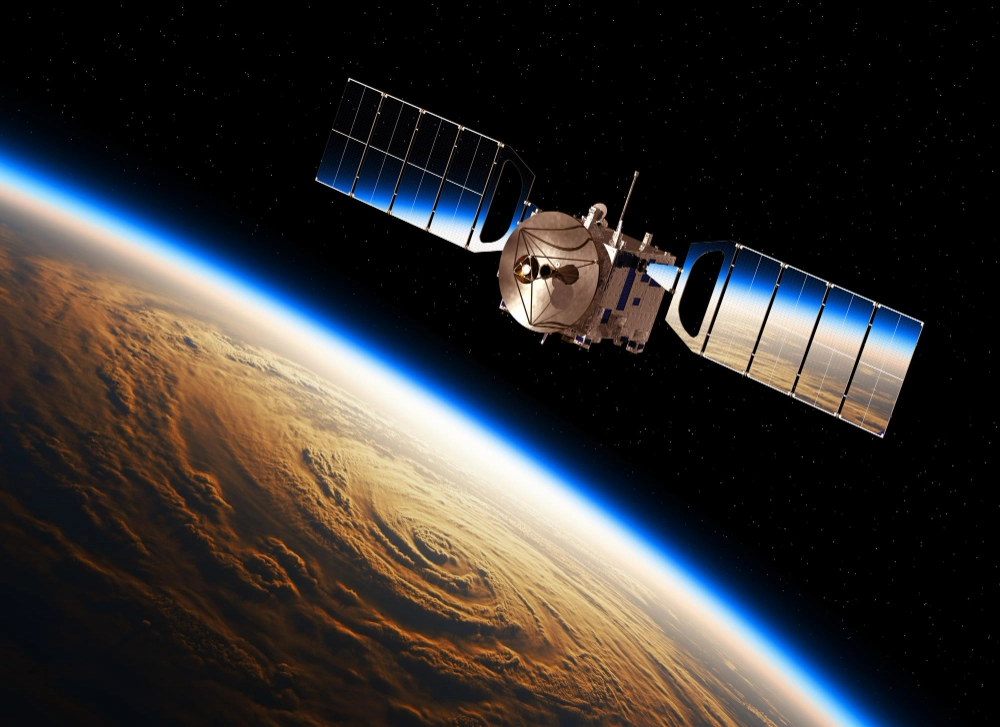
The successful launch of GESat GEN1 in January 2025 marked a major milestone in that journey. Developed as an emerging Copernicus Contributing Mission, GESat demonstrates Europe’s ability to rapidly design, deploy, and operate a new generation of greenhouse gas monitoring missions.
But launching a satellite is only the beginning.
The value of methane monitoring depends on the ability to transform complex measurements into reliable, actionable information that can support decision-making for industry, governments, and environmental organizations. Achieving this requires a complete ecosystem spanning mission planning, satellite operations, data processing, and analytics.
For this meeting, Sensing presented the end-to-end architecture that makes this possible.
Turning Space Measurements into Actionable Insights
GESat is designed to detect and quantify methane emissions at high spatial resolution, enabling the identification of emission sources across energy infrastructure, landfills, mining operations, and other industrial sites.
Behind every methane concentration map lies a sophisticated processing chain developed entirely by Sensing teams.
The presentation detailed how raw satellite observations are transformed into methane products through advanced calibration, image alignment, atmospheric modelling, and retrieval algorithms. By combining physics-based modelling with efficient processing techniques, Sensing is able to generate high-quality methane intelligence at operational scale while maintaining rigorous scientific standards.
This capability is fundamental to the company’s ambition of supporting near-real-time environmental monitoring and future large-scale services.
Innovation Driven by Operational Requirements
A key message of the presentation was that innovation at Sensing is driven not only by scientific performance, but by operational usability.
From the earliest stages of mission design, the objective has been to build systems capable of delivering reliable and repeatable information that can be integrated into real-world workflows.
This approach has led to the development of proprietary technologies across the entire value chain, including:
- Dedicated methane-sensitive instrument architectures
- Advanced image processing and calibration methods
- Fast physics-guided atmospheric retrieval models
- Automated plume detection and emission quantification algorithms
- Scalable cloud-based processing capabilities
Together, these technologies form the foundation of a new generation of methane monitoring services designed for operational deployment.
From Demonstration to Operational Service
The results shared during EO Open Science reflect the progress achieved since GESat entered operation.
Over the past year, the mission has successfully acquired and processed hundreds of observations worldwide, supporting both technology validation and service development. These operational experiences are continuously improving the performance, robustness, and scalability of the platform.
At the same time, Sensing is preparing the next phase of its roadmap.
The long-term objective is to evolve from a single-satellite mission toward a constellation architecture capable of increasing revisit frequency, accelerating detection times, and expanding monitoring coverage. Combined with advances in artificial intelligence and automated analytics, this evolution will enable faster identification of emission events and more comprehensive environmental intelligence products.
The Future of Atmospheric Intelligence
As methane reduction becomes a global priority, demand for accurate, transparent, and operational monitoring solutions continues to grow.
The technologies presented at EO Open Science demonstrate Sensing’s commitment to addressing this challenge through innovation, scientific excellence, and operational delivery.
By combining advanced space infrastructure, proprietary processing technologies, and a clear roadmap toward constellation-scale services, Sensing is helping build the future of atmospheric intelligence—turning Earth observation data into actionable information that supports climate action, regulatory compliance, and sustainable industrial operations.
We thank the EO Open Science community for the opportunity to share our progress and look forward to continuing collaborations that advance the operational use of Earth observation for climate impact.